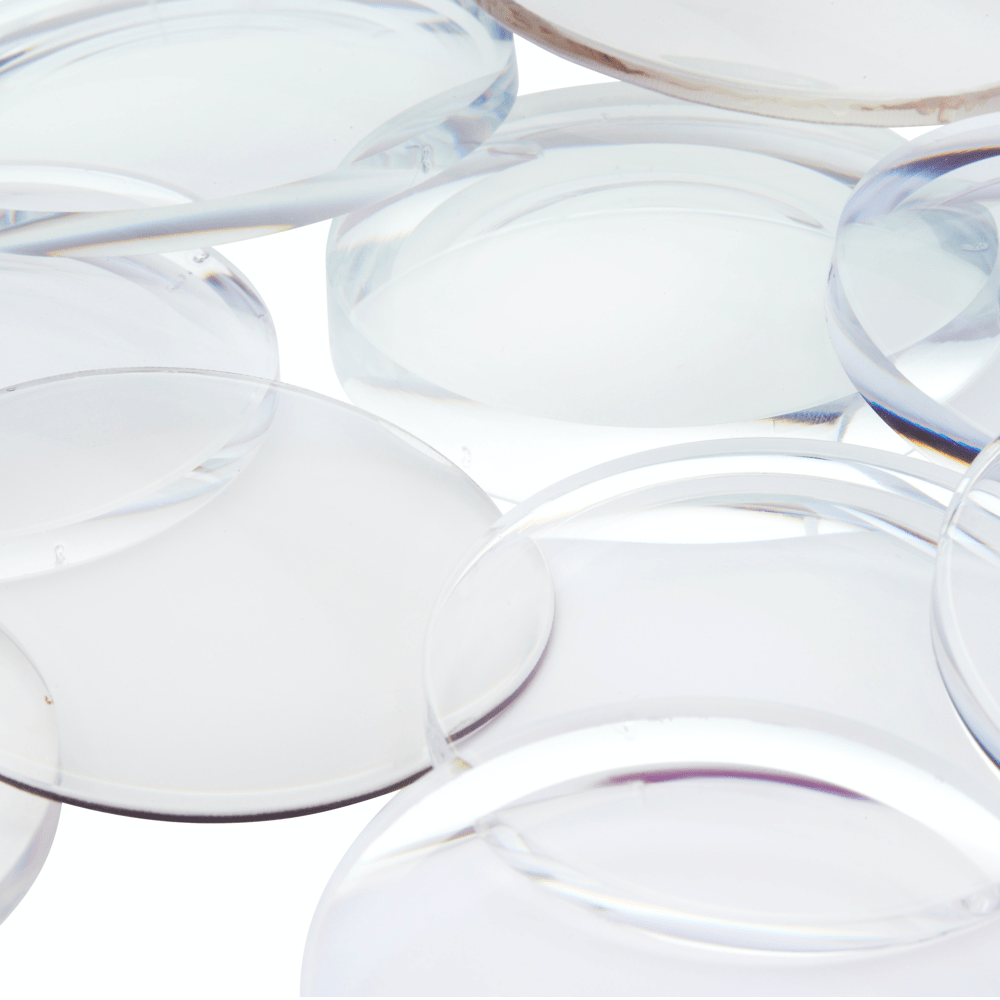
Thinned or high-index lenses are lenses that are made thinner during manufacturing so that they fit the frame you like better. Every prescription lens corrects your vision by bending light, and the stronger the prescription, the more material the lens needs to do it. A high-index lens gives you exactly the correction you need, but in a slimmer, lighter lens. That brings some clear advantages, and also a few points worth keeping in mind, which we explain below.
What are high-index (thinned) lenses?
As we have just mentioned, thinned lenses are lenses whose refractive index has been changed to achieve the same prescription with a thinner lens. A material with a higher index bends light more efficiently, so less thickness is needed for the same correction. In other words, the stronger your prescription, the more you will notice the difference, and the thinner your lens can be if you choose to go for it.

Advantages of high-index lenses
Thinned lenses have several advantages:
- They are tougher. Because the material is denser and the lens is smaller, it is a harder and more resistant lens.
- They are thinner. This means they can be fitted to a much wider range of frames.
- They are lighter. Being thinner, they also weigh less, so your glasses are more comfortable to wear. Remember that lenses, whether plastic or glass, rest on your ears and nose all day long, so the lighter they are, the more comfortable you will feel.
- They look better. In certain frames, such as metal frames, the edge of the lens is much less noticeable, so your glasses look more elegant and are more flattering.
Things to keep in mind with high-index lenses
- Plus lenses (the ones that correct long-sightedness, or hyperopia) are thicker in the centre, so that is where most of the thinning takes place.
- Minus lenses (the ones that correct short-sightedness, or myopia) are thicker at the edges, so they can be trickier to fit into some frames.
- As for frames, it is worth knowing that full-rim acetate frames are the ones that hide the thickness of the lens best.
- An index of 1.6 is usually recommended for frames where the lens sits in a groove (for example, semi-rimless frames held by a nylon thread), because the lens is stronger and this prevents it from chipping when it is fitted into the frame.

Our advice
At the end of the day, we are talking about your eyes, your comfort and your visual health. So when it comes to choosing the index of your lenses, the best thing is to ask a professional, who will recommend the most suitable option for your prescription and your frame.
At Lens4Glasses we have a team of qualified opticians and optometrists who will look at your case and offer you the best solution for your needs. With our team you will be in good hands and get honest, expert advice.
It is as simple as choosing your preferences on our website, sending us your prescription and your frame, and we take care of the rest: we fit the new lenses in your own frame and send your glasses back to you.
Ask us anything, with no obligation!