What are occupational lenses? Put simply, they are lenses designed for work. However, not every lens works equally well for every kind of job we do. Some are more comfortable for working at a computer and other digital devices, others for reading paper documents, others for working outdoors… In this post we explain what occupational lenses are, how they differ from ordinary glasses and which activities they are best suited to.
Occupational lenses
Occupational lenses, often called office lenses or computer glasses, are the most comfortable type of lens for working at a computer or with documents that force us to concentrate our eyes on them for many hours. When people work without them, many complain of neck or back pain. That happens because their glasses do not let them find a comfortable posture for long hours in front of a screen: to see clearly, they tend to lean in far too close.
That is exactly why occupational lenses exist. They give people who spend many hours in front of a computer more physical and visual comfort. Their design lets you see sharply at several working distances, so it is much easier to sit comfortably without losing focus. Another advantage is that they can be made for virtually any prescription, which makes them accessible to everyone, and they can be combined with other treatments such as a blue light filter (ideal for screens) and an anti-reflective coating.
What makes occupational lenses special?

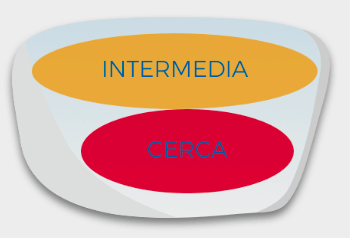
Occupational lenses are designed so that you can focus at different distances without any extra effort, which makes them ideal for working with digital devices. You no longer need to move close to the screen to see it sharply; you can read it comfortably from a slightly longer, more natural distance.
With these lenses you can see clearly at 1 metre, 2 metres or, at most, around 4 metres: in other words, the whole of your desk, your screen and the room around you.
Can they be made to my prescription?
Yes. Occupational lenses can be made to your prescription and adapted to all kinds of prescriptions. If you are not sure whether they are right for you, just ask us!
What results can you expect from occupational lenses?

When we work for many hours at a computer or any other digital device, we usually feel tired at the end of the day, especially in the upper back, the neck, the shoulders and even the lower back. This is because our eyes are not comfortable, so we tend to lean forward and adopt unhealthy postures to see the screen or the documents. As we mentioned above, occupational lenses reduce this eye strain and, as a result, allow us to adopt better, more ergonomic postures while we work, because we no longer have to strain our eyes or our back to see the elements on the screen clearly.
It is not only the back that suffers, either. The blue light from screens, combined with poor focus, often causes headaches. So, with occupational lenses and a blue light filter, the headaches that can appear from dizziness and eye strain are also greatly reduced.
In conclusion, occupational lenses are the ideal choice for working with digital devices in a way that is comfortable and healthy for our back, our brain and our eyes. They let us focus at different distances without making an extra effort that could be harmful. And if you add certain treatments, such as an anti-reflective coating or a blue light filter, you get the perfect lenses for work.
At Lens4Glasses we offer a wide range of occupational lenses, which we fit into your favourite frame. We make them in our own lab and send your glasses back to your home. You can see the price of each option in the configurator, and our opticians will be happy to answer any questions with no obligation.