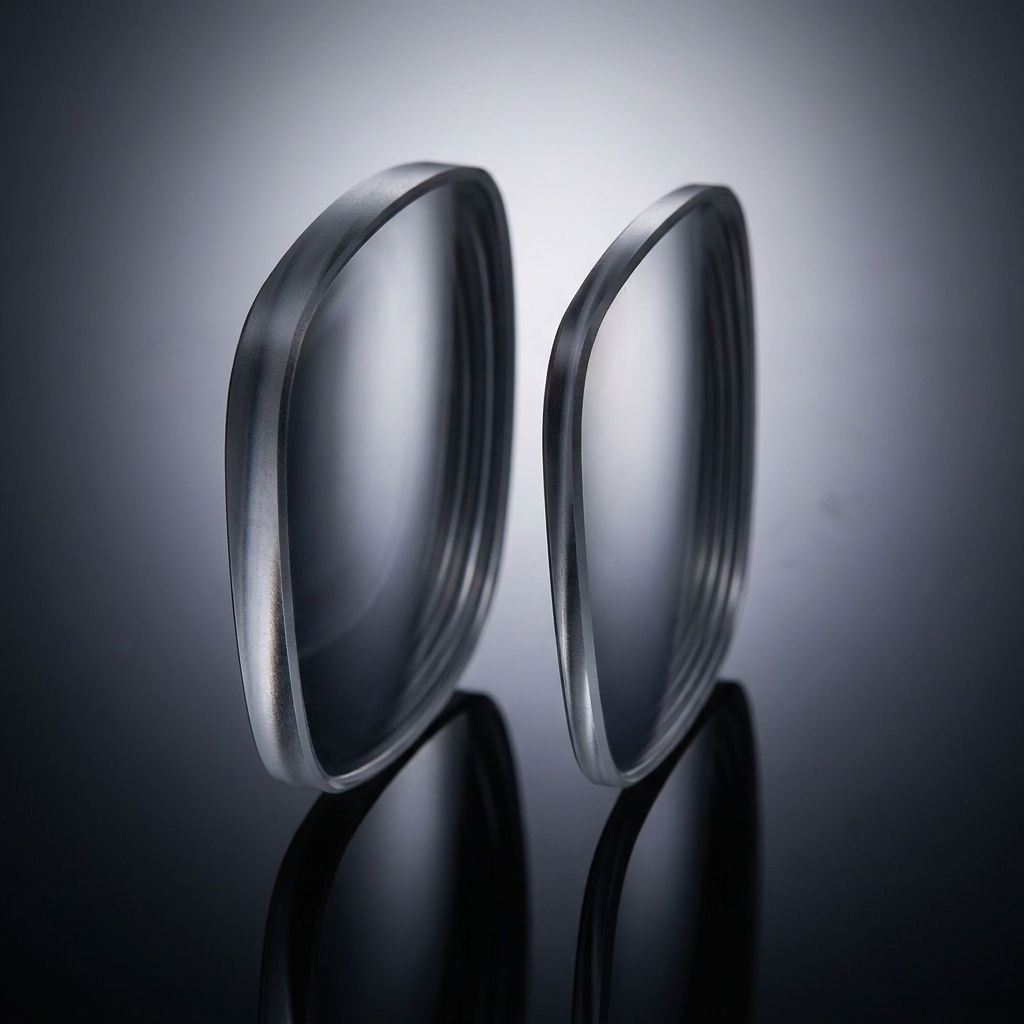
If your prescription is above 4-5 diopters (myopia or hyperopia), you’ve probably already run into the problem: standard lenses turn out thick, heavy, and sometimes give that classic «tiny eyes» or «huge eyes» look. The solution isn’t to just live with it: higher refractive indexes exist, which achieve the same correction with a noticeably thinner, lighter lens.
What is a lens «index»?
The refractive index measures how much a material bends light. The higher the index, the less material is needed to achieve the same prescription — and so the thinner and lighter the lens. The common indexes are:
- 1.50 / 1.53 — standard, the thickest, suitable for low prescriptions (up to ±2-3).
- 1.60 — a first step toward thinner lenses, recommended from ±3-4.
- 1.67 — noticeably thinner, the most common option for medium-high prescriptions (±4-8).
- 1.74 — the thinnest and lightest available, designed for very high prescriptions (+8 or more).
1.67 vs 1.74: which one do I need?
There’s no exact rule — it also depends on your frame and the lens’s diameter — but as a general guide:
Choose 1.67 if:
- Your prescription is between 4 and 8 diopters.
- You want a good balance between thickness, weight and price (1.74 is more expensive).
- Your frame has a moderate size (not very large).
Choose 1.74 if:
- Your prescription is above 8 diopters.
- Your frame is large (the wider the lens, the more the edge thickness shows).
- You prioritize maximum comfort in weight, even at a higher cost.
Something many opticians don’t explain well
The index isn’t the only thing that affects the final thickness. Your frame size matters a lot too: with the same prescription, a small, round frame leaves a thinner lens than a large, square one, because there’s less distance between the optical centre and the edge. If you’re unsure, learn how to measure your frame and check with our opticians before choosing an index — we help you with no obligation.
Does a high index sacrifice optical quality?
No. With a good anti-reflective coating (which we always recommend on high indexes, since they reflect slightly more light at the edge), visual quality is identical. The difference is only in the thickness and weight of the lens, not in sharpness.
Where do I choose the index?
The index isn’t a separate product — it’s an option within each lens type’s configurator:
Frequently asked questions
Is a high index compatible with progressive or Varilux/Zeiss lenses?
Yes, you can combine any index with progressive, Varilux or Zeiss lenses in our configurator.
How much more expensive is 1.74 compared to 1.67?
The difference varies depending on the base lens type; you can see the exact price for each index in the configurator before deciding.
I have a high prescription but a small frame — do I still need a high index?
A small frame already helps keep the lens thinner, but from certain diopters onward (typically +6/-6) it’s still advisable to go up in index. Our opticians can confirm this with your exact prescription.
Is anti-reflective coating mandatory with a 1.67 or 1.74 index?
It’s not mandatory, but it is highly recommended: high indexes reflect slightly more light, and anti-reflective coating corrects that effect and improves the lens’s appearance.