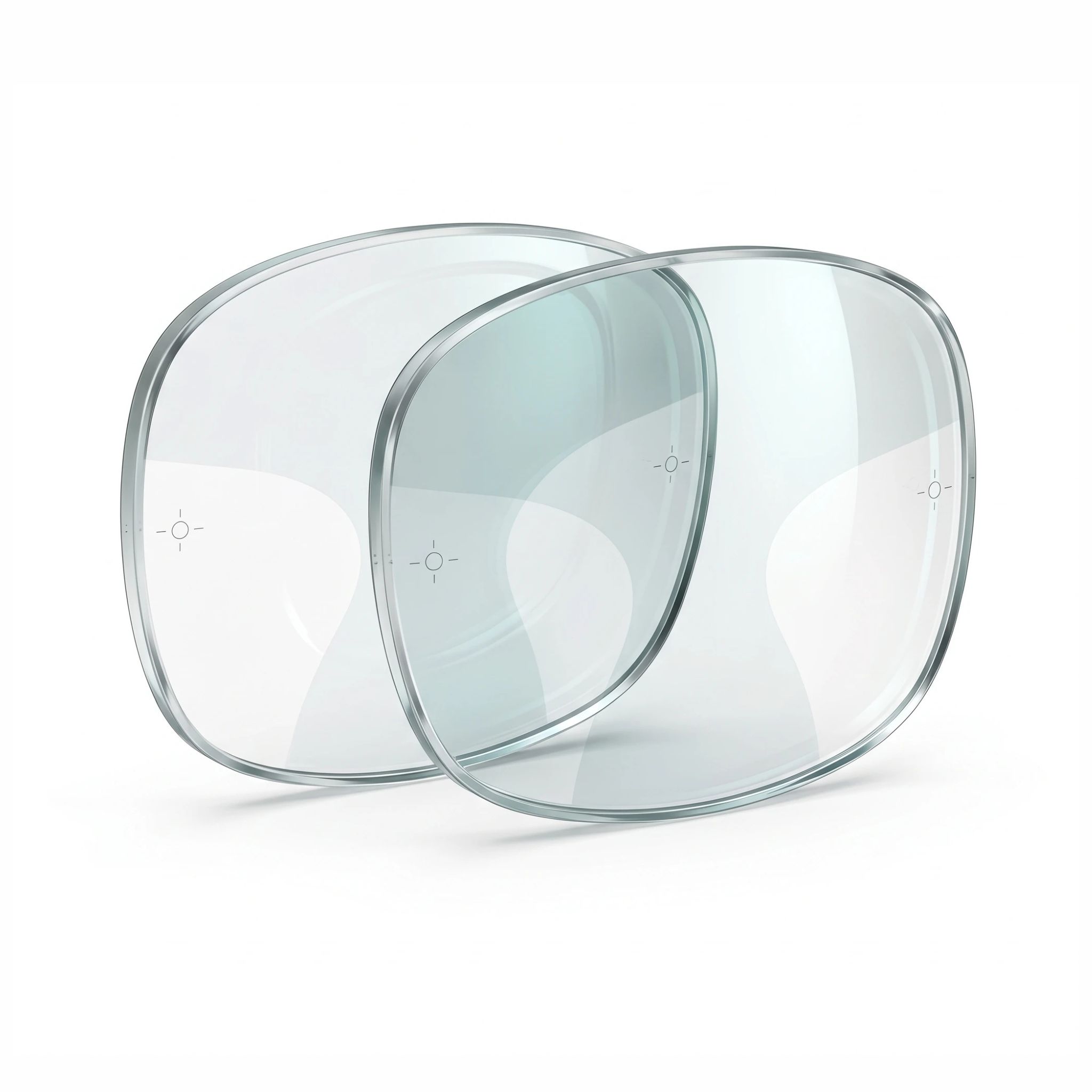
Progressive lenses (also known as varifocals) are the most comfortable way to see clearly far away, at mid-distance and up close with just one pair of glasses. If you’ve started holding your phone further away to read, or taking your glasses off to see up close, this guide explains what they are, the types available, what affects the price and how to get used to them without stress.
What are progressive lenses?
A progressive lens (also called multifocal) spreads your prescription across three zones with no visible lines:
- Top zone, distance: for driving, watching TV or walking down the street.
- Intermediate zone: for the computer, the car dashboard or the kitchen, at arm’s length.
- Bottom zone, near: for reading, looking at your phone or close-up detail work.
Between one zone and the next, the power changes gradually along a “corridor”. At the sides of that corridor there are areas with some distortion: this is normal in any progressive lens. What sets one range apart from another is how wide the corridor is and how small those side areas are.
Who needs progressive glasses?
Progressive glasses are designed for presbyopia, which usually appears from around 40-45: the eye’s lens loses flexibility and focusing up close gets harder. They are especially useful if:
- you already wear glasses for distance (short-sightedness, long-sightedness or astigmatism) and now also need help to read;
- you don’t want to keep swapping between distance glasses and reading glasses;
- your day mixes driving, screens and reading.
If you spend almost your whole working day at a computer, occupational glasses, with a wider mid-distance field, may suit you better as a second pair for work.
How to tell if you need progressives
Presbyopia comes on gradually and many people take a while to notice it. These are the most common signs:
- you hold your phone, the restaurant menu or medicine leaflets further away to read them;
- you need more light than before to read or sew;
- your eyes feel tired or itchy, or you get a headache, after a while reading or at the computer;
- with your distance glasses you see the road clearly, but struggle with your phone or the dashboard;
- you push your glasses up onto your forehead or look over the top of them to see up close.
If several of these sound familiar, it’s a good idea to have your eyes tested by an optometrist or an ophthalmologist. The clearest clue is on your prescription: if it includes an addition (ADD), for example “ADD +1.50”, you need extra power for near vision and your prescription can be used to make progressive lenses. If the numbers are confusing, we explain them step by step in how to read your eye prescription.
To make progressive glasses we need the distance prescription for each eye, the addition and, if you have it, your pupillary distance. If anything is missing, don’t worry: our opticians take the centring measurements with your frame when your glasses arrive.
Types of progressive lenses
All quality progressive lenses today are made with digital (freeform) technology, but they don’t all have the same design:
- Standard progressive: good vision at all three distances with a narrower corridor. Recommended for low prescriptions or for trying progressives for the first time.
- Advanced progressive (for example, Kodak Precise): a wider intermediate zone and easier adaptation. A good option for everyday use with screens.
- Premium progressive (for example, Kodak Unique DRO): a personalised design with less side distortion, made for strong prescriptions or demanding wearers.
- Premium-brand progressives such as Varilux by Essilor, one of the market’s benchmarks. If you can’t decide between brands, we have a Varilux vs ZEISS comparison.
Quick comparison of ranges
| Range | Who it suits | What you will notice |
|---|---|---|
| Standard | Low prescriptions or first-time wearers | Narrower corridor |
| Kodak Precise | Daily use with screens | Wider intermediate zone |
| Kodak Unique DRO | High prescriptions or demanding wearers | Less peripheral distortion |
| Varilux (Essilor) | Those who want the reference brand | Depends on the series |
Progressive lens price
The price of progressive glasses depends mainly on three things: the design range, the index (how thin the lens is) and the treatments (anti-reflective, blue light filter, photochromic…). Buying complete progressive glasses also adds the cost of the frame.
If your frame is in good condition, you can replace just the lenses. At Lens4Glasses our progressive lenses are fitted in your own frame, with anti-reflective and hard coating included, in standard, Kodak and Varilux ranges. You can see the exact price of your combination in the configurator before you pay, and our guide to how much it costs to replace the lenses in your glasses compares all the options.
New progressive glasses or just new lenses?
When it’s time to get your first progressives or replace them, the question is nearly always the same: do I buy new glasses, or put new lenses in the frame I already have? It mostly depends on the condition of your frame and how happy you are with it.
Replacing just the lenses makes sense if…
- you like your frame and it fits you well: you already know it doesn’t pinch, doesn’t slip and suits you;
- it’s in good condition: no cracks, firm hinges, straight arms and nose pads in place;
- it has enough height for the three zones (as a guide, a lens height of around 28-30 mm);
- it’s a designer or good-quality frame you don’t want to swap for a lesser one.
New progressive glasses may be the better choice if…
- the frame has loose or damaged hinges, cracks, broken solder joints or dried-out acetate;
- it’s very shallow, so the distance and near zones would be too cramped;
- you no longer like it or it isn’t comfortable, even though it’s in good shape;
- you can’t be without your glasses for a few days and have no spare pair while we make your lenses.
With the Lens4Glasses service you send us your glasses, we make the progressive lenses to your prescription, fit them in your frame and send them back to you. You’ll see the collection and delivery cost in the basket before you pay. If, when your frame arrives, we find it isn’t suitable for progressives, we’ll let you know before making anything.
Which index to choose
- 1.5: for low prescriptions.
- 1.6: thinner and lighter; recommended from medium prescriptions or with thin-rimmed frames.
- 1.67: for strong prescriptions, when you want the lens edge to show as little as possible.
If you’re not sure which one you need, send us your prescription and an optician will advise you before we make your lenses.
How to get used to progressive glasses
Most people get used to their first progressive lenses in one to three weeks. In the first few days it’s normal for the floor to feel a little “floaty” on the stairs, or to notice some distortion when you look out of the corner of your eye. These tips help a lot:
- Wear them all day from the start, rather than on and off.
- Turn your head, not just your eyes: point your nose at what you want to see, so you look through the centre of the lens.
- To read, lower your eyes without lowering your head: the near zone is at the bottom.
- On stairs and kerbs, tilt your head down slightly to look through the distance zone.
- Set your screen slightly below eye level so you can use the intermediate zone comfortably.
If you still feel uncomfortable after three or four weeks, the centring or the design usually needs checking. That’s why our progressives come with a 90-day adaptation guarantee: if you can’t see well, we check it at no cost.
Your first 15 days with progressive glasses: what’s normal and what isn’t
The first two weeks are when most questions come up. Knowing what to expect helps you avoid leaving your new glasses in a drawer too soon.
Normal during adaptation
- Mild dizziness or a slightly unsteady feeling in the first few days, especially when you move quickly or turn your head.
- A “floating” floor, or steps that seem nearer or further away when you go downstairs.
- Slightly blurred side vision, or straight lines that bend a little when you look out of the corner of your eye: these are the side areas of the progressive lens.
- Having to find the sweet spot to read or see the screen, moving your head a little.
- These effects ease off day by day and, in most cases, are barely noticeable after one or two weeks.
Signs the centring or design needs checking
- distance vision isn’t sharp even when you look straight ahead through the centre of the lens;
- to read, you have to lift your chin a lot or slide your glasses down your nose;
- the clear area seems shifted to one side, or you only see well with one eye;
- the discomfort doesn’t improve at all from one week to the next, or gets worse;
- the frame has moved: it’s crooked, sits lower or rests differently than before.
If you notice any of these signs, write to us with your order number and tell us what’s happening and in which situations. Often a simple frame adjustment fixes it; if not, we check the centring, design or index under the 90-day adaptation guarantee. And if you have a severe headache, double vision or any symptom that persists, see your optometrist or ophthalmologist.
Progressive, bifocal or occupational
- Progressive: the most complete option to wear all day, with no visible line.
- Bifocal: two zones (distance and near) separated by a line; no intermediate zone, but very quick to get used to.
- Occupational: a wider near and mid-distance field; ideal as office glasses, not for driving.
We explain it in more detail in which type of lenses to choose.
Can I have progressive lenses fitted in my frame?
In most cases, yes. The frame needs some height so the three zones fit properly: as a guide, a lens height of at least 28-30 mm. Full-rim, nylon (semi-rimless) and many rimless frames are compatible. When we receive your glasses, our qualified opticians check the frame and take the centring measurements before making the lenses.
Progressive lenses FAQ
Can you drive with progressive glasses?
Yes. The top zone is for distance and it’s the one you use when driving; the intermediate zone lets you see the dashboard.
How long do progressive lenses last?
You usually replace them when your prescription changes, which with presbyopia tends to happen every two or three years. The lenses themselves come with a 3-year guarantee. It is also worth replacing them if the lenses are scratched or the coating is worn. As the addition usually increases over the years, have regular eye tests with your optometrist or ophthalmologist, even if you think you still see well.
Are progressive lenses good for computer work?
Yes, through the intermediate zone. If you work many hours in a row on screens, a pair of occupational glasses as a second pair will give you a wider field.
What if I can’t get used to them?
With our 90-day adaptation guarantee, we check the centring, design or index at no cost.
Can you play sport in progressive glasses?
For walking, hiking, gentle cycling or golf, yes. For contact sports or very fast-moving ones such as padel or football, everyday glasses aren’t the safest choice: people usually wear dedicated sports glasses or contact lenses. Your optometrist can advise you depending on the sport.
What if my frame is small?
If the lens height is below around 28-30 mm, the distance and near zones become very cramped and adapting is harder. When your glasses arrive we measure the frame and, if it isn’t suitable, we tell you before making anything so you can decide.
Are progressive lenses good for night driving?
Yes, you drive through the distance zone just as you do by day. The anti-reflective coating, which is included, reduces reflections from headlights and street lamps. If you see halos or glare at night that don’t go away, it’s worth having your eyes checked by your optometrist or ophthalmologist.
Can I have progressives with anti-reflective, blue light filter or photochromic lenses?
Yes. All our progressives come with anti-reflective and hard coating, and depending on the range you can add a blue light filter or photochromic lenses, which darken in the sun, in the configurator. Bear in mind that photochromic lenses darken very little inside a car, because the windscreen blocks much of the UV light.
Can progressive lenses be fitted in sunglasses?
Yes, as long as the frame is tall enough and its curve allows prescription lenses to be fitted; very curved or wraparound sports frames don’t always allow it. If you’d like tinted or photochromic lenses, write to us before sending your frame and we’ll tell you which options suit it.