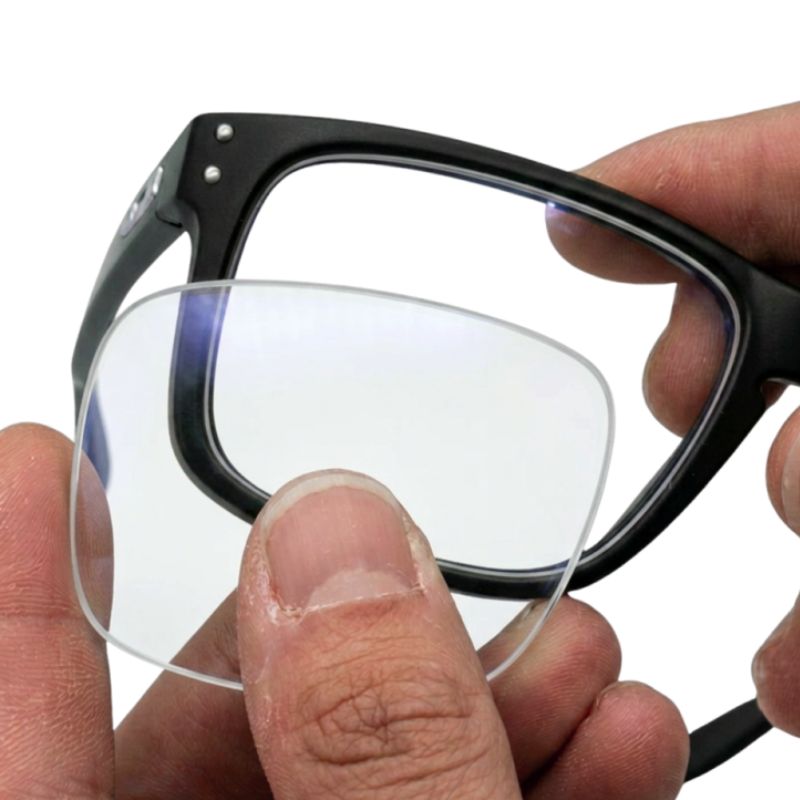
If your frame is still in good shape and you only need new lenses, there’s no need to pay for a whole new pair of glasses. Here are the real prices, depending on the lens type you need:
| Lens type | Estimated price* | What it’s for |
|---|---|---|
| Single-vision | From €30 | One prescription, for distance or near vision |
| ZEISS | From €89 | Single-vision lenses with maximum optical quality from a premium brand |
| Progressive | From €99 | Distance, intermediate and near, no visible lines |
| Varilux | From €290 | Essilor’s premium progressive lenses |
| Occupational | From €129 | Office work and screens |
| Bifocal | From €119 | Two distances with a visible line |
| Non-prescription | From €20 | Just renewing the lens, no correction |
*Price per pair of lenses, frame not included. The final price depends on the index and treatments you choose (anti-reflective, blue light filter, photochromic, polarized…).
Every price is for the pair of lenses, made and fitted into your own frame: you send us your glasses, we make the lenses to your prescription, fit them and send your glasses back ready to wear.
If you are considering progressive glasses, our guide to progressive lenses explains what they are, the types available, what they cost and how to get used to them.
Why does the price vary so much depending on the lens type?
- Lens design: a single-vision lens (one prescription) is simpler to make than a progressive lens, which needs several vision zones in the same lens.
- Brand/lab: ZEISS and Varilux are premium brands with their own design technology, which is reflected in the price compared to a standard range.
- Lens index: the thinner and lighter (1.60, 1.67, 1.74), the higher the price — here we explain when you need it.
- Treatments: anti-reflective, hardened, blue light filter, photochromic and polarized are added as options, each with its own cost.
What makes the price of prescription lenses go up
The price of prescription lenses starts from a simple base: a clear single-vision lens in index 1.5, with anti-reflective and hard coating already included, from €30 a pair. From there, each choice you make in the configurator adds to or changes the price. These are the factors that matter most:
1. The index (how thin the lens is)
The index tells you how thin the lens will be. For low prescriptions, index 1.5 is enough; as the prescription goes up, a higher index gives the same correction with less thickness and weight. Index 1.6 adds €30, 1.67 adds €60 and the thinnest, 1.74, adds €135 and also requires the premium anti-reflective coating (+€20).
2. Coatings
Anti-reflective and hard coating are already included in the base price. If you want a premium anti-reflective coating, it costs €20 more. A blue light filter is an option designed for people who spend many hours in front of screens.
3. Photochromic, tinted or polarized
Lenses that darken in the sun (photochromic), tinted sun lenses and polarized lenses use a different material or process, so each has its own starting price. Tinted is the most affordable of the three and polarized the most premium.
4. The type of frame
In a full-rim plastic or metal frame, fitting is included. In a rimless frame (the lenses are held with screws or drilled holes), the workshop job is more delicate and adds €30.
5. Brand and design
ZEISS single-vision lenses start at €89, and progressive lenses go from €99 in our standard range up to branded designs such as Kodak or Varilux. A more advanced design usually means wider fields of vision and easier adaptation, especially with progressives.
Summary of single-vision options and supplements (per pair, fitted into your frame):
| Option | Price or supplement |
|---|---|
| Clear 1.5 with anti-reflective and hard coating | From €30 |
| Tinted sun lenses | From €40 |
| Blue light filter | From €60 |
| Photochromic | From €90 |
| Polarized | From €130 |
| Index 1.6 | +€30 |
| Index 1.67 | +€60 |
| Index 1.74 | +€135 (+€20 for the required premium anti-reflective) |
| Premium anti-reflective | +€20 |
| Rimless frame | +€30 |
You see the exact amount of each option in the configurator as you select it.
Price by prescription
Your prescription itself does not change the base price: what changes it is the index that suits you so the lens doesn’t end up thick. As a guide, for clear single-vision lenses with anti-reflective coating:
- Low prescription (up to about ±3 dioptres): index 1.5 is usually enough. From €30.
- Medium prescription (±3 to ±4): 1.6 is a first step in thinning. From €60 (€30 + €30).
- Medium-high prescription (±4 to ±8): 1.67 is the most common choice. From €90 (€30 + €60).
- Very high prescription (over ±8): 1.74 is the thinnest. From €185 (€30 + €135 + €20 for the required premium anti-reflective).
These ranges are a guide: the size and shape of the frame also affect the final thickness. A small frame helps keep the lens thinner, and in a rimless frame the lens edge is visible, so a higher index makes more of a difference there.
Example quotes
To give you a realistic idea, here are some common cases and what to choose, with our ‘from’ prices per pair, fitting in your frame included. The exact price for each one appears in the configurator as soon as you enter your prescription:
Myopia of -2 with anti-reflective coating
With a low prescription, a clear 1.5 single-vision lens is enough, and it already includes anti-reflective and hard coating: from €30, our most affordable prescription option. If you prefer the premium anti-reflective, the total is €50 (€30 + €20).
High astigmatism with index 1.67
For example, a prescription of -5 with -2.50 astigmatism. The sensible choice is a thinner lens in index 1.67: from €90 (€30 + €60). With the premium anti-reflective, €110 (€30 + €60 + €20).
Kodak Precise progressive lenses
If you need to see far, at mid distance and up close with the same glasses and want a branded design, Kodak Precise lenses cost from €199. For reference, our standard progressive lenses start at €99 and the top-of-the-range Kodak Unique DRO at €339.
Non-prescription polarized sunglasses
To renew the lenses of sunglasses with no prescription: non-prescription sun lens from €20 + polarized €30 = from €50. If you prefer photochromic instead of polarized, from €60 (€20 + €40).
Why is it cheaper than buying new glasses?
When you buy new glasses, you pay for frame + lenses, even if your current frame is perfectly fine. By replacing only the lenses:
- You don’t pay again for a frame you already own.
- You only pay for the lenses and fitting, not for new glasses.
- You keep the frame you’re already comfortable with (or simply love).
Replace the lenses or buy new glasses?
Replacing only the lenses makes sense when:
- The frame is in good condition: no cracks, firm hinges and no warping.
- You like your frame, it fits you well or it has special value (a designer frame, a gift, a model that is no longer made).
- Your prescription has changed or your lenses are scratched, but the glasses themselves are still comfortable.
- You want to turn glasses you already own into progressives, prescription sunglasses or photochromic glasses.
Buying new glasses makes more sense when:
- The frame is broken, badly warped or the material has become brittle over the years.
- You want a new look and the frame no longer suits you.
- The frame is very large for a high prescription and the lens would still be thick even with a thin index.
How do I see the exact price for my case?
The final price depends on your prescription, the lens type and the treatments you choose — that’s why we don’t give a “fixed” price on this page. Go into the lens type you need, enter your prescription (or indicate you don’t have it yet) and you’ll see the exact quote instantly, with no sign-up or commitment.
See all lens types and configure mine →
Frequently Asked Questions
Does the price include shipping?
Return shipping is free on orders over €50. Collection is free in mainland Spain and Portugal; elsewhere its cost is shown in the basket before you pay.
Is there a hidden cost at the end, or is the quote final?
The quote you see in the configurator is the final price, with no surprises when you receive your order.
Can I replace just one lens if the other one is fine?
We explain it here — you don’t need to replace both if only one is damaged.
Is the price the same if my prescription is very high?
The base price is the same, but if you need a thinner index so the lens doesn’t come out too thick, that treatment has an additional cost — here we explain when you need it.
Does astigmatism cost more?
There is no supplement for astigmatism: the base price is the same. It only goes up if, because your prescription is high, you choose a thinner index. To learn more, we explain what astigmatism is and how it is corrected.
How long does it take to replace the lenses?
As a guide, clear single-vision lenses take 2 to 7 working days and progressive lenses 5 to 10 working days.
Can I use my old prescription?
You can enter the prescription you have. However, if you notice you don’t see as well as before or your prescription is not recent, it is worth having your eyes tested first: the lenses are made exactly to the values you give us.
What if my frame is rimless?
We also replace lenses in rimless frames. Fitting is more delicate and carries a supplement of €30 a pair.
Do the lenses come with a guarantee?
Yes, the lenses have a 3-year guarantee. With progressive lenses you also get a 90-day adaptation guarantee.