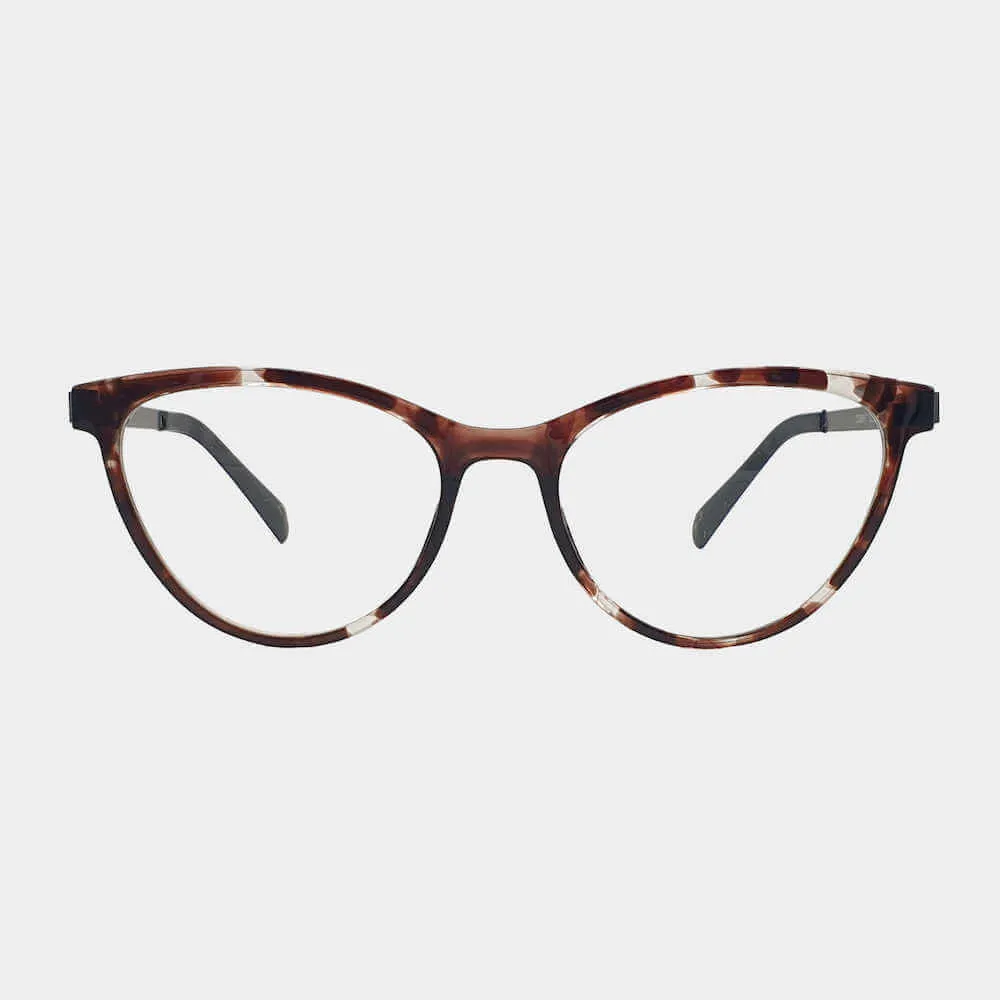
Clip-on sunglasses solve a very specific problem: if you wear prescription glasses, heading out on a sunny day means carrying two pairs or paying for prescription sunglasses. With a sun clip that sits in front of your prescription lenses, you get both in a single frame. In this article we explain how they work, their advantages and their drawbacks, and we answer the question we get asked most: do clip-on glasses work with progressive lenses?
What are clip-on sunglasses?
They are ordinary prescription glasses that come with a sun clip made to fit the frame. There are two systems:
- Magnetic clip: the frame and the clip have small magnets in matching positions. Bring the clip close and it snaps into place; pull it away by hand and it comes off. It’s the system used on all Lens4Glasses clip-on glasses.
- Flip/clamp clip: a universal attachment that hooks onto the bridge with a clamp. It fits almost any pair of glasses, but it doesn’t have the exact shape of your frame, usually leaves gaps at the sides, and over time the clamp can mark or scratch the lens.
A magnetic clip is designed for its frame: same shape, same size, so with the clip on, the glasses look like a single pair of sunglasses.
Advantages of clip-on sunglasses
- One pair of glasses for the whole day. In the morning you wear them as your everyday glasses and, when the sun comes out, you attach the clip without taking your glasses off. Walk into a shop, the office or a tunnel and it comes off in a second.
- You only pay for your prescription once. The prescription lenses go into a single frame and the sun clip is already included. No need for a second pair of prescription sunglasses.
- Polarised clip. All our clips are polarised: they cut the glare reflected off tarmac, car bonnets and water, which is the most dazzling kind.
- If your prescription changes, the clip still works. Just replace the lenses in the same frame; the clip has no prescription, so it doesn’t need changing.
- Two looks from one frame: with or without the clip, the glasses change style.
Drawbacks: what you should know before buying
It’s not all upside. These are the real downsides of clip-on glasses, so you can decide with all the facts:
- You have to carry the clip with you. When you’re not using it, it needs to go in its case or your pocket. If you lose it, the glasses still work as your everyday glasses, but you’re left without sun protection.
- A little extra weight with the clip on. It’s two pieces instead of one. Day to day you’ll barely notice, but on a very thin frame or with thick lenses you’ll feel it a bit more than with a single pair of sunglasses.
- The clip only fits its own frame. A magnetic clip can’t be used on a different pair of glasses: each clip is made for the shape and magnets of its model.
- Less side protection than wraparound sunglasses. The clip covers the front of the glasses, not the sides. For mountain or snow sports with a lot of light coming from the side, sports sunglasses offer better coverage.
- With screens, watch out for polarisation. Some car displays, phone screens or cash machines look darker through a polarised filter, depending on the angle. If it bothers you, just take the clip off for a moment.
- At night, always without the clip. No sun clip is suitable for driving at night.
Our verdict: are they worth it?
If you wear your glasses all day and spend time in the sun, yes. They are the most convenient and affordable way to have everyday glasses and prescription sunglasses in one frame, especially if you drive every day, walk a lot around town or travel and don’t want to carry two cases.
Where they fit least is for people who spend many hours at a stretch in the sun (beach, mountains, skiing) and want maximum side protection: there, prescription sunglasses are a better choice, for example by adding your prescription to your own branded sunglasses.
Do clip-on sunglasses work with progressive lenses?
Yes, and it’s one of the cases where they pay off most. The clip sits in front of your lenses and has no prescription: it changes nothing about how you see through your progressive lenses (varifocals). You still have the distance zone at the top, the intermediate zone in the middle and the reading zone at the bottom, just with a polarised sun filter in front.
The main advantage is cost. A separate pair of progressive sunglasses means paying for varifocals twice. With clip-on glasses you pay for them once and the sun protection is already included in the frame.
Two things to bear in mind with progressives:
- Frame height. A progressive lens needs vertical space to fit all three zones. As a guide, the lens should be around 28-30 mm tall or more. Very shallow frames can cut into the reading zone. Each model’s measurements are on its product page; if in doubt, ask us before ordering.
- Centring. As with any progressive lens, the pupil height is measured with your frame. Our registered optometrists/opticians fit the lenses to your prescription and send you the glasses ready to wear.
Sun clip, prescription sunglasses or photochromic lenses
| Clip-on sunglasses | Prescription sunglasses | Photochromic lenses | |
|---|---|---|---|
| How many pairs | One frame and one clip | Two pairs (everyday and sun) | One pair |
| Switching to sun mode | Instantly, by attaching the clip | By changing glasses | Automatic, takes a while to darken and clear |
| Polarised | Yes, on all our clips | Optional | Usually not |
| Inside the car | Works the same | Works the same | Barely darken: the windscreen filters the light that activates them |
| Prescription you pay for | Once | Twice | Once |
If you drive a lot, a polarised clip is usually a better option than photochromic lenses, which barely darken inside the car.
Price of prescription glasses with a magnetic clip
- Frame with polarised clip: €59 or €99, depending on the model.
- With single vision lenses (distance or reading): +€30. On the €99 models, the complete glasses start from €129.
- With progressive lenses: +€99, i.e. from €198 with the clip included. You can also choose Varilux progressives.
- For strong prescriptions, thinner indices and a premium anti-reflective coating are available as options.
All glasses come with a 3-year guarantee on frame and lenses and 14-day returns. You can also order just the frame with its clip and take it to your local optician.
How to choose your clip-on glasses
- Choose the shape: we have cat eye, butterfly, round, square, hexagonal, rectangular and aviator models, in TR90 (light and flexible), metal or acetate.
- Check the size: compare the lens width and bridge with those of your current glasses, usually printed on the inside of the temple arm. If they’re similar (about 2 mm either way), the fit will be similar. We explain how in how to measure your frame.
- If you wear progressives, also check the lens height on the product page.
- Add your lenses with your prescription, or order just the frame.
You can see all the models in our prescription clip-on glasses with magnetic clip category.
Frequently asked questions
Does the magnetic clip fall off?
Not with normal use: the magnets hold it firmly. The key is to take your glasses off by holding the frame, not by pulling on the clip.
Can I put a clip on my current glasses?
Not a magnetic one: it has to be made for that frame. For your current glasses, only a universal clamp clip would work, with the downsides we covered above.
Are clip-on glasses good for driving?
During the day, yes: you have your prescription and you put the clip on or take it off depending on the light, and the polarisation reduces glare from wet roads and the windscreen. At night, always without the clip.
Can any clip-on glasses take a prescription?
Yes. All our clip-on frames accept single vision and progressive lenses.
What do I do if I lose or break the clip?
Write to us with your glasses model and we’ll help you find a solution.